
Private jet categories and aircraft types
The right aircraft is the one that fits the mission — never the largest.
Last updated 13 July 2026
Private jets fall into five charter categories — light, midsize, super-midsize, heavy and ultra-long-range — with the very light jet and the turboprop below them, and the helicopter for transfers. Each maps to a mission: range, cabin and capacity rise from a two-hour European hop to a fifteen-hour intercontinental non-stop.
The five categories at a glance
The market sorts business aircraft into five charter categories, defined less by their names than by what they let you do: how far you can fly without stopping, how many travel in comfort, and what the cabin offers once you are aboard. Below them sits the very light jet; alongside, turboprops and helicopters cover the ground the jets cannot.
Read the table as a map of missions, not a ranking. The right aircraft is the one whose range clears your route in a single flight and whose cabin suits the way you want to travel — no larger.
| Category | Passengers | Range / time | Cabin | Representative models | Best for |
|---|---|---|---|---|---|
| Light jet | 5–7 | ≈ 1,500–2,000 nm · 2–3 h | Seated cabin, enclosed lavatory | Phenom 300, Citation CJ3/CJ4 | Short hops: Geneva–Nice, Paris–London |
| Midsize | 7–8 | ≈ 2,500–3,000 nm · 3–4 h | Stand-up cabin, enclosed lavatory | Citation XLS+/Latitude, Praetor 500 | Transcontinental Europe, US with a stop |
| Super-midsize | 8–9 | ≈ 3,400–3,600 nm · 5–6 h | Flat-floor stand-up, galley, lavatory | Challenger 350, Praetor 600, Citation Longitude | US coast-to-coast non-stop, Europe–Gulf |
| Heavy jet | 10–14 | ≈ 4,000–5,000 nm · 6–8 h | Stand-up zones, galley, berthing | Challenger 650, Falcon 900, Gulfstream G500 | Transatlantic non-stop, larger groups |
| Ultra-long-range | 12–16 | ≈ 6,000–8,000 nm · 13–15 h | Multiple zones, stateroom, shower on some | Gulfstream G650/G700, Global 7500 | Intercontinental non-stop: Dubai–New York |
Light jets — agility over the short haul
The light jet is the workhorse of regional private travel. Five to seven passengers, a cabin sized for seated comfort rather than standing, an enclosed lavatory, and enough range for two to three hours in the air — the length of most intra-European or short domestic legs.
Representative families include the Embraer Phenom 300, the most-delivered light jet of its generation, and the Cessna Citation CJ series; the Learjet 70/75 and the Pilatus PC-24 sit in the same tier. They reach smaller airports close to your destination, which is often where the real time is saved.
Best for: Geneva–Nice, Paris–London, Milan–Ibiza — quick point-to-point hops for a small party who value speed and access over a stand-up cabin.
Midsize and super-midsize — the versatile core
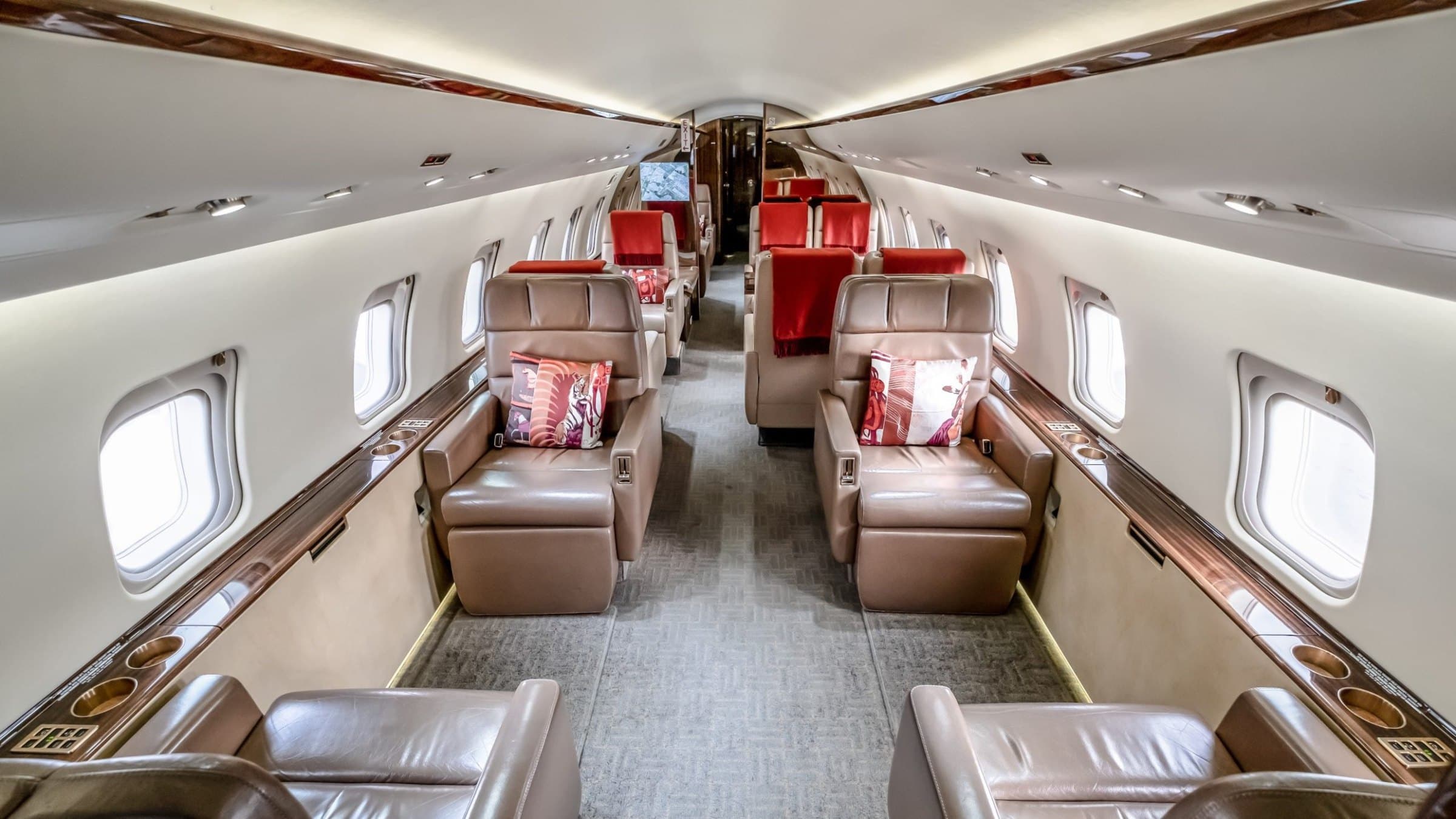
This is where the cabin stands up. The midsize carries seven or eight in a cabin you can walk through, with an enclosed lavatory and room to work or rest across a three-to-four-hour flight — transcontinental Europe, or the United States with a single fuel stop.
The super-midsize is the quiet sweet spot of charter. A flat-floor stand-up cabin, a proper galley, an enclosed lavatory, and the range — roughly 3,400 to 3,600 nautical miles — to cross the United States coast-to-coast non-stop or link Europe to the Gulf. The Bombardier Challenger 350, the Embraer Praetor 600 and the Cessna Citation Longitude define the class.
Best for: the traveller who wants transcontinental reach and a cabin to live in, without stepping up to heavy-jet cost. For many missions, it is the most balanced choice on the board.
Heavy jets and ultra-long-range — the world without a stop
The heavy jet opens the intercontinental door. Ten to fourteen passengers, standing cabins often divided into zones, a full galley, and berthing to sleep on a red-eye — with four to five thousand nautical miles of range, enough for a transatlantic crossing non-stop. The Bombardier Challenger 650, the Dassault Falcon 900 and the Gulfstream G500 are representative.
Ultra-long-range is the summit. Twelve to sixteen passengers across multiple living zones, a private stateroom, a full galley, two lavatories and, on aircraft such as the Gulfstream G650ER, the G700 and the Bombardier Global 7500, a shower. Six to eight thousand nautical miles of range turn Dubai–New York, Hong Kong–London or Los Angeles–Sydney into a single flight.
Best for: crossing oceans without stopping, arriving rested, and travelling as a group or a family in a cabin that feels like a residence. Above these sit the ‘bizliners’ — converted Airbus and Boeing airframes — for those who want an apartment aloft.
Turboprops, VLJ and helicopters — the edges of the fleet
Two rungs sit below the jet categories, and one beside them. The very light jet is the most economical way to fly private on a short leg for one or two people — four seats, an hour or two of range, a cabin you sit in rather than stand up in. The Embraer Phenom 100, the HondaJet and the Cirrus Vision Jet are typical.
The turboprop trades a little speed for access. A Pilatus PC-12 or a Beechcraft King Air reaches short, unpaved and high-altitude runways no jet can use — the mountain airstrip, the island, the private field — often more economically than a jet on legs under 500 nautical miles.
The helicopter is not a charter category but the connective tissue of a journey: the last mile a runway cannot cover. Nice to Monaco in roughly seven minutes, apron to a yacht's helideck, a heliport in the heart of a city. We fold it into the door-to-door plan rather than treating it as a separate booking.
| Aircraft | Passengers | Reach | Where it earns its place |
|---|---|---|---|
| Very light jet (VLJ) | 4–5 | ≈ 1,000–1,300 nm · ~2 h | The most economical jet for one or two on a short leg |
| Turboprop | 6–9 | ≈ 1,000–1,800 nm · slower | Short, unpaved and high runways no jet can use |
| Helicopter (transfer) | 4–7 | Local · minutes | The last mile — Nice–Monaco in ~7 min, apron to yacht |
Choosing the aircraft for the mission, not the mission for the aircraft
The instinct to reach for the largest aircraft is usually the wrong one. A jet whose range clears your route in one flight, with a cabin sized to your party, will nearly always serve you better — and cost less — than a bigger aircraft carrying empty seats and unused reach.
Four questions decide it: how far, non-stop or with a fuel stop; how many aboard; how long in the air, and therefore how much cabin you will actually want; and which airports serve your true origin and destination. Answer those and the category chooses itself.
This is the judgement we bring to every brief. We match the aircraft to the mission, name the trade-offs plainly, and let the route — not the temptation of size — decide.
Aircraft — frequently asked
Five: light, midsize, super-midsize, heavy and ultra-long-range, from the regional hop to the intercontinental non-stop. Below them sit the very light jet and the turboprop, and the helicopter handles transfers. Each category answers a particular balance of range, capacity and cabin.
From the midsize up, the cabin stands up. Light jets and very light jets offer seated headroom — very comfortable on short flights, but you do not walk about upright. The super-midsize adds a flat floor that noticeably changes the feel on board.
Heavy jets and ultra-long-range aircraft cross the Atlantic non-stop; some super-midsize jets do too, on the right routing and winds. For Dubai–New York or Hong Kong–London, an ultra-long-range is required.
The ultra-long-range class. Aircraft such as the Gulfstream G650ER, the G700 and the Bombardier Global 7500 offer a private stateroom and, on some, a shower — designed to arrive rested after thirteen to fifteen hours aloft.
Range and cabin. The super-midsize crosses the United States non-stop and offers a flat-floor stand-up cabin with a galley, where the midsize often needs a stop and gives a more compact cabin. The super-midsize is frequently the best range-to-cost balance.
The turboprop earns its place on short legs (under 500 nautical miles) and for reaching short, unpaved or high-altitude runways. The helicopter solves the last mile — airport to yacht, to a city centre or to an event — when the road would cost too much time.
Everything for your private flight
Unsure which aircraft fits?
Tell us the route, the party and the date. We will name the right category for the mission — never larger — with a clear quote and everything the journey needs on either side of the flight.